Comparative Effectiveness of Mindfulness-Based Stress Reduction and Compassion-Focused Therapy on Food Literacy and Gastrointestinal-Specific Anxiety in Patients With Irritable Bowel Syndrome
Keywords:
Irritable Bowel Syndrome, Mindfulness-Based Stress Reduction, Compassion-Focused Therapy, Food Literacy, Gastrointestinal-Specific AnxietyAbstract
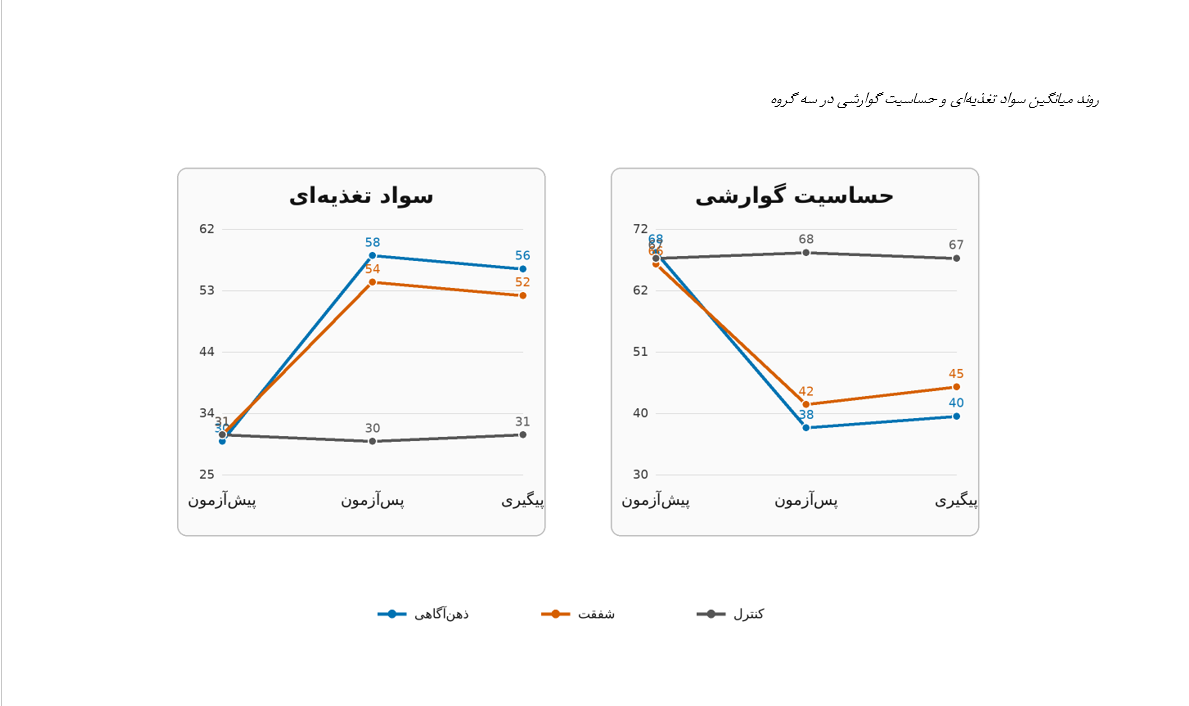
Irritable bowel syndrome (IBS) is a chronic disorder of gut-brain interaction. Its symptom experience is linked to stress, gastrointestinal-specific anxiety, and health-related behavior. This study compared mindfulness-based stress reduction (MBSR) and compassion-focused therapy (CFT) for improving food literacy and reducing gastrointestinal-specific anxiety in patients with IBS. A quasi-experimental pretest-posttest-follow-up design with a control group was used. Forty-five eligible patients were randomly allocated to MBSR, CFT, or control conditions (n = 15 per group). The active groups received eight group sessions, whereas the control group received no psychological intervention during the study period. Food literacy was assessed with the Short Food Literacy Questionnaire, and gastrointestinal-specific anxiety was measured with the Visceral Sensitivity Index. Data were analyzed using analysis of covariance, mixed repeated-measures analysis, and Bonferroni-adjusted pairwise comparisons. After baseline adjustment, the group effect was significant for posttest food literacy, F(2, 41) = 196.26, p < .001, partial η² = .91, and gastrointestinal-specific anxiety, F(2, 41) = 182.34, p < .001, partial η² = .90. Both active interventions produced more favorable outcomes than the control condition. At posttest, MBSR differed from CFT for food literacy (adjusted p = .041) and gastrointestinal-specific anxiety (adjusted p = .045); neither difference remained significant at follow-up. Time-by-group interactions were significant for both outcomes, and follow-up means in the active groups remained close to their posttest values. MBSR and CFT were associated with favorable and relatively sustained changes in self-reported outcomes. The small short-term advantages of MBSR were not maintained at follow-up; therefore, the findings support both approaches as potential adjunctive interventions rather than demonstrating definitive superiority. Replication with larger samples, active controls, complete protocol reporting, and independently verified clinical outcomes is warranted.
References
Baboș, C. I., Leucuța, D. C., & Dumitrașcu, D. L. (2022). Meditation and irritable bowel syndrome: A systematic review and meta-analysis. Journal of Clinical Medicine, 11(21), 6516. https://doi.org/10.3390/jcm11216516
Black, C. J., Thakur, E. R., Houghton, L. A., Quigley, E. M. M., Moayyedi, P., & Ford, A. C. (2020). Efficacy of psychological therapies for irritable bowel syndrome: Systematic review and network meta-analysis. Gut, 69(8), 1441-1451. https://doi.org/10.1136/gutjnl-2020-321191
Drossman, D. A., & Hasler, W. L. (2016). Rome IV—Functional GI disorders: Disorders of gut-brain interaction. Gastroenterology, 150(6), 1257-1261. https://doi.org/10.1053/j.gastro.2016.03.035
Ford, A. C., Sperber, A. D., Corsetti, M., & Camilleri, M. (2020). Irritable bowel syndrome. The Lancet, 396(10263), 1675-1688. https://doi.org/10.1016/S0140-6736(20)31548-8
Garland, E. L., Gaylord, S. A., Palsson, O., Faurot, K., Mann, J. D., & Whitehead, W. E. (2012). Therapeutic mechanisms of a mindfulness-based treatment for IBS: Effects on visceral sensitivity, catastrophizing, and affective processing of pain sensations. Journal of Behavioral Medicine, 35(6), 591-602. https://doi.org/10.1007/s10865-011-9391-z
Gaylord, S. A., Palsson, O. S., Garland, E. L., Faurot, K. R., Coble, R. S., Mann, J. D., Frey, W., Leniek, K., & Whitehead, W. E. (2011). Mindfulness training reduces the severity of irritable bowel syndrome in women: Results of a randomized controlled trial. The American Journal of Gastroenterology, 106(9), 1678-1688. https://doi.org/10.1038/ajg.2011.184
Ghaffari Jahed, Z., Amini, N., Direh, E., & Mirzaei, K. (2020). Effectiveness of compassion-focused therapy on pain perception and perfectionism in men with irritable bowel syndrome. Medical Journal of Mashhad University of Medical Sciences, 63(4). https://doi.org/10.22038/mjms.2020.17479
Gilbert, P. (2009). The compassionate mind: A new approach to life's challenges. Constable & Robinson. https://www.researchgate.net/profile/Susan-Stuntzner/publication/281900130_Book_Review_Paul_Gilbert_2009_The_Compassionate_Mind_A_New_Approach_to_Life's_Challenges/links/56ddd61508aed4e2a99c5f30/Book-Review-Paul-Gilbert-2009-The-Compassionate-Mind-A-New-Approach-to-Lifes-Challenges
Krause, C. G., Beer-Borst, S., Sommerhalder, K., Hayoz, S., & Abel, T. (2018). A short food literacy questionnaire (SFLQ) for adults: Findings from a Swiss validation study. Appetite, 120, 275-280. https://doi.org/10.1016/j.appet.2017.08.039
Labus, J. S., Bolus, R., Chang, L., Wiklund, I., Naesdal, J., Mayer, E. A., & Naliboff, B. D. (2004). The Visceral Sensitivity Index: Development and validation of a gastrointestinal symptom-specific anxiety scale. Alimentary Pharmacology & Therapeutics, 20(1), 89-97. https://doi.org/10.1111/j.1365-2036.2004.02007.x
Lacy, B. E., Pimentel, M., Brenner, D. M., Chey, W. D., Keefer, L. A., Long, M. D., & Moshiree, B. (2021). ACG clinical guideline: Management of irritable bowel syndrome. The American Journal of Gastroenterology, 116(1), 17-44. https://doi.org/10.14309/ajg.0000000000001036
Millard, L. A., Wan, M. W., Smith, D. M., & Wittkowski, A. (2023). The effectiveness of compassion focused therapy with clinical populations: A systematic review and meta-analysis. Journal of Affective Disorders, 326, 168-192. https://doi.org/10.1016/j.jad.2023.01.010
Oka, P., Parr, H., Barberio, B., Black, C. J., Savarino, E. V., & Ford, A. C. (2020). Global prevalence of irritable bowel syndrome according to Rome III or IV criteria: A systematic review and meta-analysis. The Lancet Gastroenterology & Hepatology, 5(10), 908-917. https://doi.org/10.1016/S2468-1253(20)30217-X
Portokali, S., Hajializadeh, K., & Samavi, A. (2019). Adaptation and psychometric properties of the Visceral Sensitivity Index (VSI). Clinical Psychology and Personality, 16(2), 239-246. https://cpap.shahed.ac.ir/article_2874_en.html
Sala, M., Rochefort, C., Lui, P. P., & Baldwin, A. S. (2020). Trait mindfulness and health behaviours: A meta-analysis. Health Psychology Review, 14(3), 345-393. https://doi.org/10.1080/17437199.2019.1650290
Vasant, D. H., Paine, P. A., Black, C. J., Houghton, L. A., Everitt, H. A., Corsetti, M., Agrawal, A., Aziz, I., Farmer, A. D., Eugenicos, M. P., Moss-Morris, R., Yiannakou, Y., & Ford, A. C. (2021). British Society of Gastroenterology guidelines on the management of irritable bowel syndrome. Gut, 70(7), 1214-1240. https://doi.org/10.1136/gutjnl-2021-324598
Zernicke, K. A., Campbell, T. S., Blustein, P. K., Fung, T. S., Johnson, J. A., Bacon, S. L., & Carlson, L. E. (2013). Mindfulness-based stress reduction for the treatment of irritable bowel syndrome symptoms: A randomized wait-list controlled trial. International Journal of Behavioral Medicine, 20(3), 385-396. https://doi.org/10.1007/s12529-012-9241-6
Downloads
Publication Timeline
- Submitted
- Revised
- Accepted
Issue
Section
License
Copyright (c) 2025 سیدعلیرضا سیدابراهیمی (نویسنده); منیژه فیروزی; مریم آفرینی بادی (نویسنده)

This work is licensed under a Creative Commons Attribution-NonCommercial 4.0 International License.