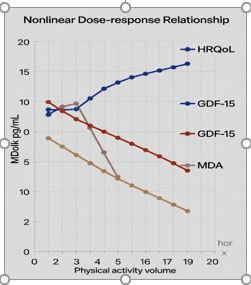
رابطه دوز-پاسخ بین حجم فعالیت بدنی کلی، کیفیت زندگی مرتبط با سلامت و سطوح GDF-15 و MDA در بزرگسالان ۶۵ تا ۸۵ ساله
DOI:
https://doi.org/10.61838/kman.longevity.68کلمات کلیدی:
تمرین ورزشی, سالمندی, کیفیت زندگی مرتبط با سلامت, آسیب اکسیداتیوچکیده
فرآیند سالمندی با کاهش کیفیت زندگی مرتبط با سلامت (HRQoL) همراه است که اغلب با افزایش نشانگرهای بیولوژیکی مانند فاکتور تمایز رشد ۱۵ (GDF-15) به عنوان نشانگر آسیبپذیری و استرس سلولی و مالوندیآلدئید (MDA) به عنوان نشانگر آسیب اکسیداتیو لیپیدی، تشدید میشود. این نشانگرها نقش کلیدی در پیشبینی زوال فیزیولوژیکی و بیماریهای مرتبط با سن ایفا میکنند. این مطالعه مشاهدهای مقطعی با هدف بررسی رابطه دوز-پاسخ بین حجم فعالیت بدنی کلی ، HRQoL و سطوح سرمی GDF-15 و MDA در بزرگسالان ۶۵ تا ۸۵ ساله انجام شد. ۲۰۰ شرکتکننده (۱۰۵ زن، ۹۵ مرد؛ میانگین سن ۲/۵ ± ۱/۷۴ سال) از جامعه سالمندان فعال در تهران انتخاب شدند. حجم تمرین هفتگی با استفاده از پرسشنامه بینالمللی فعالیت بدنی (IPAQ-SF) اندازهگیری و به سه سطح (کم <۱۵۰ دقیقه/هفته)، متوسط (۱۵۰-۳۰۰ دقیقه) و بالا ( >۳۰۰ دقیقه) تقسیم گردید. HRQoL با پرسشنامه SF-36 ارزیابی شد و مقادیر GDF-15 و MDA از طریق آزمایش خون ناشتا تعیین گردید. تحلیل آماری شامل رگرسیون خطی چندمتغیره، ANOVA بود. افزایش حجم تمرین با بهبود معنادار نمره (۰۰۱/۰ p=۴۷/۰ HRQoL (β =، کاهش سطوح GDF-15 (۰۰۱/۰ p= ۳۵/۰- (β =و MDA (۰۰۱/۰ p=۳۰/۰- (β = همراه بود. رابطه دوز-پاسخ غیرخطی بود و بیشترین بهبود در سطوح متوسط تا بالا مشاهده شد. تفاوتهای جنسیتی نیز نشان داد که زنان پاسخ بهتری به تمرین متوسط نشان میدهند. افزایش حجم فعالیت بدنی با کاهش سطوح GDF-15 و MDA (نشانگرهای آسیبپذیری سلولی و آسیب اکسیداتیو) و بهبود کیفیت زندگی مرتبط با سلامت همراه بود. این یافتهها نشاندهنده ارتباط مثبت حجم فعالیت بدنی با شاخصهای سلامت در سالمندان است و بر لزوم بررسی اثرات مداخلهای تمرین در مطالعات طولی یا آزمایشی تأکید دارد. این یافتهها بر لزوم برنامهریزی مداخلات ورزشی شخصیسازیشده برای سالمندان تأکید دارد، هرچند به دلیل انتخاب نمونه از سالمندان فعال شهری، تعمیم نتایج به سالمندان کمتحرک یا ناتوان نیازمند احتیاط است.
مراجع
American Heart Association. (2018). Recommendations for physical activity in adults and kids. Available online: https://www. heart. org/en/healthy-living/fitness/fitness-basics/aha-recs-for-physical-activity-in-adults (accessed on 2 August 2021).
Ammar, A., Trabelsi, K., Boukhris, O., Glenn, J. M., Bott, N., Masmoudi, L., Hakim, A., Chtourou, H., Driss, T., & Hoekelmann, A. (2020). Effects of aerobic-, anaerobic-and combined-based exercises on plasma oxidative stress biomarkers in healthy untrained young adults. International Journal of Environmental Research and Public Health, 17(7), 2601.
Bacanoiu, M. V., Danoiu, M., Rusu, L., & Marin, M. I. (2023). New directions to approach oxidative stress related to physical activity and nutraceuticals in normal aging and neurodegenerative aging. Antioxidants, 12(5), 1008.
Carpentieri, S., Ferrari, G., & Donsì, F. (2023). High-pressure homogenization for enhanced Bioactive recovery from tomato processing by-products and improved lycopene bioaccessibility during in vitro digestion. Antioxidants, 12(10), 1855.
Chirumbolo, S., Bertossi, D., & Magistretti, P. (2023). Insights on the role of L-lactate as a signaling molecule in skin aging. Biogerontology, 24(5), 709-726.
Conte, M., Giuliani, C., Chiariello, A., Iannuzzi, V., Franceschi, C., & Salvioli, S. (2022). GDF15, an emerging key player in human aging. Ageing research reviews, 75, 101569.
El-Domiaty, H. F., El-Roghy, E. S., & Salem, H. R. (2022). Combination of magnesium supplementation with treadmill exercise improves memory deficit in aged rats by enhancing hippocampal neurogenesis and plasticity: a functional and histological study. Applied Physiology, Nutrition, and Metabolism, 47(3), 296-308.
Fairof, M. H. Z., Ludin, A. F. M., Anas, N. D., Husna, A., Hasan, A. M. C., Abdullah, A. H. A., Ibrahim, F. W., Pramono, A., & Rajab, N. F. (2025). Early Active Exercise Improves MDA, SOD, and GSH Levels without Memory or NO Changes in Wistar Rats. The Indonesian Biomedical Journal, 17(4), 335-342.
He, P., Ye, Z., Liu, M., Li, H., Zhang, Y., Zhou, C., Wu, Q., Zhang, Y., Yang, S., & Liu, C. (2023). Association of handgrip strength and/or walking pace with incident chronic kidney disease: A UK biobank observational study. Journal of Cachexia, Sarcopenia and Muscle, 14(2), 805-814.
Kim, J., Bressel, E., Kim, M., Kim, T., Koh, S., & Kim, D. (2025). The Effects of a Combined Exercise Intervention on Body Composition, GDF-15, Apelin-12, and IL-15 Among Older Korean Women According to Obesity Status. Journal of Clinical Medicine, 14(14), 4981.
Kleinert, M., Clemmensen, C., Sjøberg, K. A., Carl, C. S., Jeppesen, J. F., Wojtaszewski, J. F., Kiens, B., & Richter, E. A. (2018). Exercise increases circulating GDF15 in humans. Molecular metabolism, 9, 187-191.
Lehrer, S., & Rheinstein, P. H. (2025). Growth Differentiation Factor 15 Connects Stress and Ageing in a UK Biobank Cohort. medRxiv, 2025.2007. 2004.25330886.
Limyati, Y., Rahmia, P., & Hutapea, A. M. (2025). THE EFFECT OF RESISTANCE TRAINING AND ANTIOXIDANT SUPPLEMENTATION WITH ASTAXANTHIN ON PLASMA MALONDIALDEHYDE (MDA) LEVELS IN ADULTS. Jurnal Health Sains, 6(3), 1-12.
Liu, H., Huang, Y., Lyu, Y., Dai, W., Tong, Y., & Li, Y. (2021). GDF15 as a biomarker of ageing. Experimental gerontology, 146, 111228.
Liu, M., Fu, X., Yu, D., Li, M., Pan, Y., Yang, C., & Sun, G. (2024). Mapping the causal associations of cytokines with sarcopenia and aging traits: Evidence from bidirectional Mendelian randomization. Journal of Cachexia, Sarcopenia and Muscle, 15(3), 1121-1133.
Lyu, Z., Fan, N., Deng, P., Huang, Q., Bruns, C., & Zhao, Y. (2025). GDF15 connecting ageing and cancer: Mechanistic insights and therapeutic opportunities. Ageing and Cancer Research & Treatment, 2(2), 202509-202509.
Mohammadifard, N., Sajjadi, F., Maghroun, M., Alikhasi, H., Nilforoushzadeh, F., & Sarrafzadegan, N. (2015). Validation of a simplified food frequency questionnaire for the assessment of dietary habits in Iranian adults: Isfahan Healthy Heart Program, Iran. ARYA atherosclerosis, 11(2), 139.
Ni, C., Ji, Y., Hu, K., Xing, K., Xu, Y., & Gao, Y. (2023). Effect of exercise and antioxidant supplementation on cellular lipid peroxidation in elderly individuals: Systematic review and network meta-analysis. Frontiers in Physiology, 14, 1113270.
Papa, M. V., Ceolin, C., Boschele, F., Pagliuca, R., Sergi, G., & De Rui, M. (2025). The Stress-Responsive Cytokine GDF-15 and Sarcopenia: A Systematic Review and Meta-Analysis on Aging Muscle Decline. Mechanisms of Ageing and Development, 112117.
Piercy, K. L., Troiano, R. P., Ballard, R. M., Carlson, S. A., Fulton, J. E., Galuska, D. A., George, S. M., & Olson, R. D. (2018). The physical activity guidelines for Americans. Jama, 320(19), 2020-2028.
Susanto, I. H., Suherman, W. S., Graha, A. S., Bahauddin, M. A., & Ockta, Y. (2025). The Relationship Between Submaximal Exercise, Oxidative Stress, and Malondialdehyde (MDA) Levels as Indicators of Health and Physiological Adaptation in Athletes: A Litera-ture Review. Balneo & PRM Research Journal, 16(3).
Trumpff, C., Huang, Q., Michelson, J., Liu, C. C., Shire, D., Habeck, C. G., Stern, Y., & Picard, M. (2025). Blood mitochondrial health markers cf-mtDNA and GDF15 in human aging. bioRxiv.
Wan, R., Su, Y., Zhu, M., & Huang, Y. (2024). Elevated blood malondialdehyde level contributed to a high stroke risk in a Chinese elderly population from rural areas: a cross-sectional study. Scientific Reports, 14(1), 4325.
Wan, Y., & Fu, J. (2024). GDF15 as a key disease target and biomarker: linking chronic lung diseases and ageing. Molecular and cellular biochemistry, 479(3), 453-466.
Wang, Y., Luo, D., Jiang, H., Song, Y., Wang, Z., Shao, L., & Liu, Y. (2023). Effects of physical exercise on biomarkers of oxidative stress in healthy subjects: A meta-analysis of randomized controlled trials. Open Life Sciences, 18(1), 20220668.
Widiastuti, I. A. E., Zubaidi, F. F., Rahmat, B., & Buanayuda, G. W. (2022). Analysis of Malondialdehyde (MDA) Levels Based on Body Mass Index, Waist Circumstances, and Body Fat Percentage in Students of Medicine Program Faculty of Medicine Mataram University. Jurnal Biologi Tropis, 22(4), 1455-1461.
Ye, Y., Lin, H., Wan, M., Qiu, P., Xia, R., He, J., Tao, J., Chen, L., & Zheng, G. (2021). The effects of aerobic exercise on oxidative stress in older adults: a systematic review and meta-analysis. Frontiers in Physiology, 12, 701151.
دانلودها
گاهشمار انتشار
- ارسال
- بازنگری
- پذیرش
شماره
نوع مقاله
مجوز
حق نشر 2025 اعظم ملانوروزی, نسیم سهیلی (نویسنده)

این پروژه تحت مجوز بین المللی Creative Commons Attribution-NonCommercial 4.0 می باشد.