The effectiveness of an intervention based on conscious family games on increasing family vitality and flexibility
Keywords:
Conscious family games, family vitality, family resilience, happinessAbstract
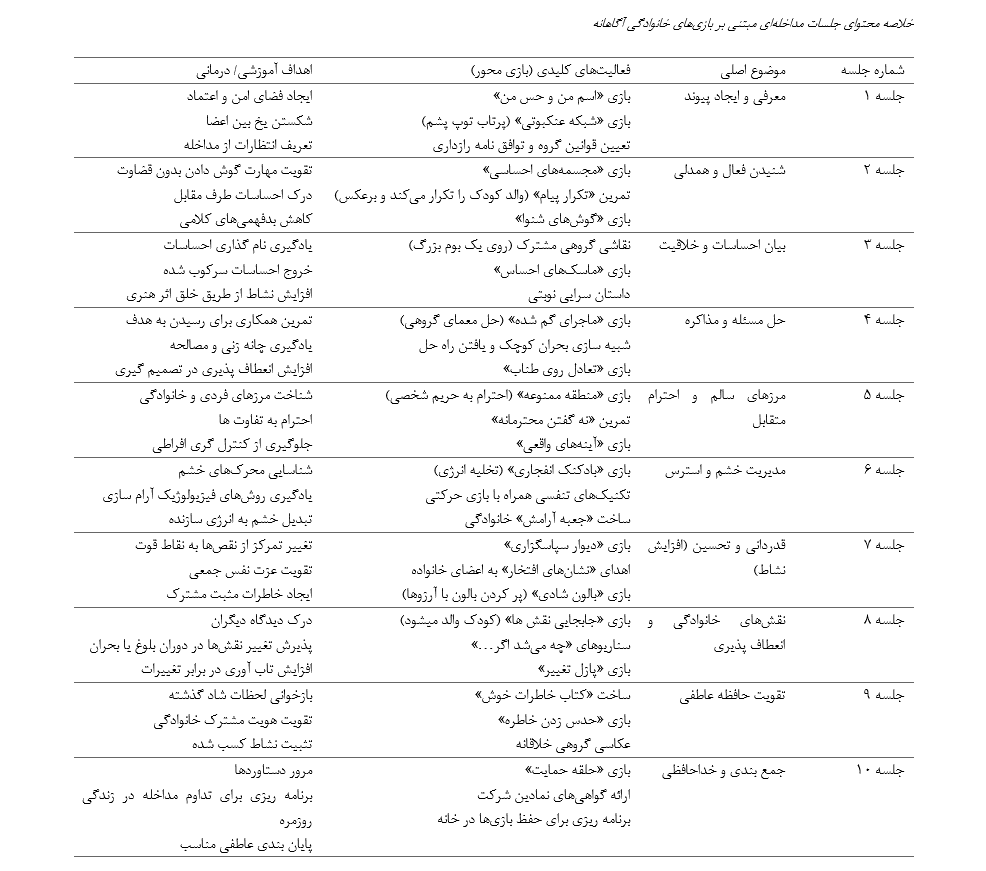
The present study aimed to investigate the effectiveness of an intervention based on conscious family games on increasing family vitality and flexibility. The research method was a quasi-experimental, pre-test, post-test design with a control group. The statistical population of this study included all families covered by welfare referring to family counseling centers in Tehran. The sampling method was simple random. 40 people were selected from the statistical population and randomly assigned to two control and experimental groups. The experimental group participated in 10 90-minute sessions of an intervention based on conscious family games. The control group did not receive training. The subjects answered the Oxford Happiness Questionnaire and the Shakeri Family Flexibility Scale (2003) before and after the intervention. The data were analyzed using the covariance method. The results showed that an intervention based on conscious family games can increase family vitality and flexibility. According to the findings, it can be concluded that conscious family games, as a low-cost, attractive, and practical solution, have high potential for intervention at preventive and therapeutic levels in vulnerable families.
References
Alabdulakareem, E., & Jamjoom, M. (2020). Computer-assisted learning for improving ADHD individuals' executive functions through gamified interventions: A review. Entertainment Computing, 33, 100341. https://doi.org/10.1016/j.entcom.2020.100341
Amodia-Bidakowska, A., Laverty, C., & Ramchandani, P. G. (2020). Father-child play: A systematic review of its frequency, characteristics and potential impact on children's development. Developmental Review, 57, 100924. https://doi.org/10.1016/j.dr.2020.100924
Choi, Y., & Lim, J. (2021). Structural relationship among parent's play participation, young children's playfulness, self-regulation and happiness. Human Ecology Research, 59(1), 71-82. https://doi.org/10.6115/fer.2021.006
Colston, R. (2023). An exploration of the effects of adult play on happiness and well-Being https://research.usc.edu.au/view/pdfCoverPage?instCode=61USC_INST&filePid=13178128060002621&download=true
Dodangeh, Z., Malek Hosseini, E., & Shamsipour Dehkordi, P. (2021). The effect of parents' attitude toward play in green spaces on children's cognitive flexibility during home quarantine. Journal of Psychology and Psychiatry of Cognition, 8(2), 100-112. https://www.sid.ir/fa/VEWSSID/J_pdf/10005214000209.pdf
Fortune, J. (2022). Why We Play: How to find joy and meaning in everyday life. Thread. https://books.google.com/books?hl=en&lr=&id=lwlxEAAAQBAJ&oi=fnd&pg=PT5&dq=Fortune,+J.+(2022).+Why+We+Play:+How+to+find+joy+and+meaning+in+everyday+life,+Thread.+%09&ots=Hz54bN4kmi&sig=dfcFVYQABbQUeEW2zRXPkycJpTA
Higgins-Klein, D. (2013). Mindfulness Based Play Family Therapy: Theory And Practice. WW Norton & Company. https://books.google.com/books?hl=en&lr=&id=dQ-aAAAAQBAJ&oi=fnd&pg=PR11&dq=Higgins-Klein,+D.+(2013).+Mindfulness+Based+Play+Family+Therapy:+Theory+And+Practice,+WW+Norton+%26+Company.+%09&ots=td14BpRm_6&sig=Kb6pVkSU2yt86upn-73snlSBDro
İçen, B. K., & Çelik, O. T. (2026). Examination of the Effects of a Play-Based Mindfulness Training Program on Resilience, Emotion Regulation Skills, and Executive Functions of Preschool Children. Children, 13(1), 110. https://doi.org/10.3390/children13010110
Kerr, B. (2025). Happy Families, Free Families. In The Psychology of Liberty: Reclaiming Everyday Freedom (pp. 125-140). Springer Nature Switzerland. https://doi.org/10.1007/978-3-031-84670-0_9
Khazaeili, Z., Kashani-Vahid, L., Vakili, S., & Afrooz, G. A. (2023). Evaluating the Effectiveness of Mindfulness-Based Family-Centered Game Programs on Emotion Regulation and Instability/Negativity of Children with Behavioral Disorders. Middle Eastern Journal of Disability Studies, 13, 141. https://jdisabilstud.org/article-1-2970-en.html
Lanjekar, P. D., Joshi, S. H., Lanjekar, P. D., & Wagh, V. (2022). The effect of parenting and the parent-child relationship on a child's cognitive development: A literature review. Cureus, 14(10). https://doi.org/10.7759/cureus.30574
Lin, X., & Li, H. (2020). Parents' play beliefs and engagement in young children's play at home. In Working with Parents and Families in Early Childhood Education (pp. 5-20). Routledge. https://doi.org/10.4324/9780429288876-2
Mengxia, L. (2024). Preschoolers' cognitive flexibility and emotion understanding: A developmental perspective. Frontiers in Psychology, 15, 1280739. https://doi.org/10.3389/fpsyg.2024.1280739
Musick, G., Freeman, G., & McNeese, N. J. (2021). Gaming as family time: Digital game co-play in modern parent-child relationships. Proceedings of the ACM on Human-Computer Interaction, 5(CHI PLAY), 1-25. https://doi.org/10.1145/3449123
Safarian, S., Salehi, K., Dehghani, M., & Karimian, Z. (2025). The effect of group games on school happiness of third-grade male students. Journal of Applied Psychological Research, 16(4), 103-118. https://japr.ut.ac.ir/article_103591.html
Shakeri, S. (2003). Investigating the effect of family flexibility on mental health of high school students in Shiraz
Soltani Banavandi, E., Khezri Moghadam, N., & Bani Asadi, H. (2019). The role of family cohesion and flexibility in predicting students' academic vitality with the mediation of meaning in life. Positive Psychology Research Journal, 5(3), 53-70. http://ppls.ui.ac.ir/article_24826.html
Sun, M. X., Zhao, Z. F., & Liu, H. (2025). Fostering intergenerational communication through games: an exploratory study on metaphorical life games in family settings. Frontiers in Public Health, 13, 1532603. https://doi.org/10.3389/fpubh.2025.1532603
Teichert, L., & Chan, V. (2025). Finding Joy in Communication with Families. Language and Literacy, 27(3), 62-86. https://doi.org/10.20360/langandlit29756
Teufl, L., & Ahnert, L. (2022). Parent-child play and parent-child relationship: Are fathers special? Journal of Family Psychology, 36(3), 416. https://doi.org/10.1037/fam0000933
Valizadeh, R., & Jangi, F. (2021). Investigating the effectiveness of play and group training on students' vitality, happiness and health. The First National Conference on Applied Ideas in Educational Sciences, Psychology and Cultural Studies, Bushehr.
Wonders, L. L. (2025). Mindfulness-based play therapy: A transtheoretical and neurobiological approach to psychotherapy with children and families. Routledge. https://doi.org/10.4324/9781003468585
Yang, Y., Bulut, S., Bukhori, B., Piskorz-Ryń, O., & Chikwe, C. (2025). The Role of Family Routines in Promoting Child Mental Health: A Qualitative Study. Journal of Research & Health, 15(2). https://doi.org/10.32598/JRH.15.2.2474.1
Zare, M., & Samani, S. (2008). Investigating the role of family flexibility and cohesion in children's goal orientation. Family Research Quarterly, 14(13), 17-36. http://journals.sbu.ac.ir/article_95097_9cdea5460c5c8c49b4148a7ee612f33c.pdf
Downloads
Publication Timeline
- Submitted
- Revised
- Accepted
Issue
Section
License
Copyright (c) 2025 اعظم مقدم فر, مژگان هیبتی, سمانه هوشیار (نویسنده); فاطمه بزرگی; شهره سادات فیلسوف (نویسنده)

This work is licensed under a Creative Commons Attribution-NonCommercial 4.0 International License.