Comparison of the Effectiveness of Two Play-Based Approaches on Motor Skills and Self-Efficacy in Children with DCD
Keywords:
Developmental Coordination Disorder, Self-Efficacy, Motor Proficiency, Cooperative Games, Competitive GamesAbstract
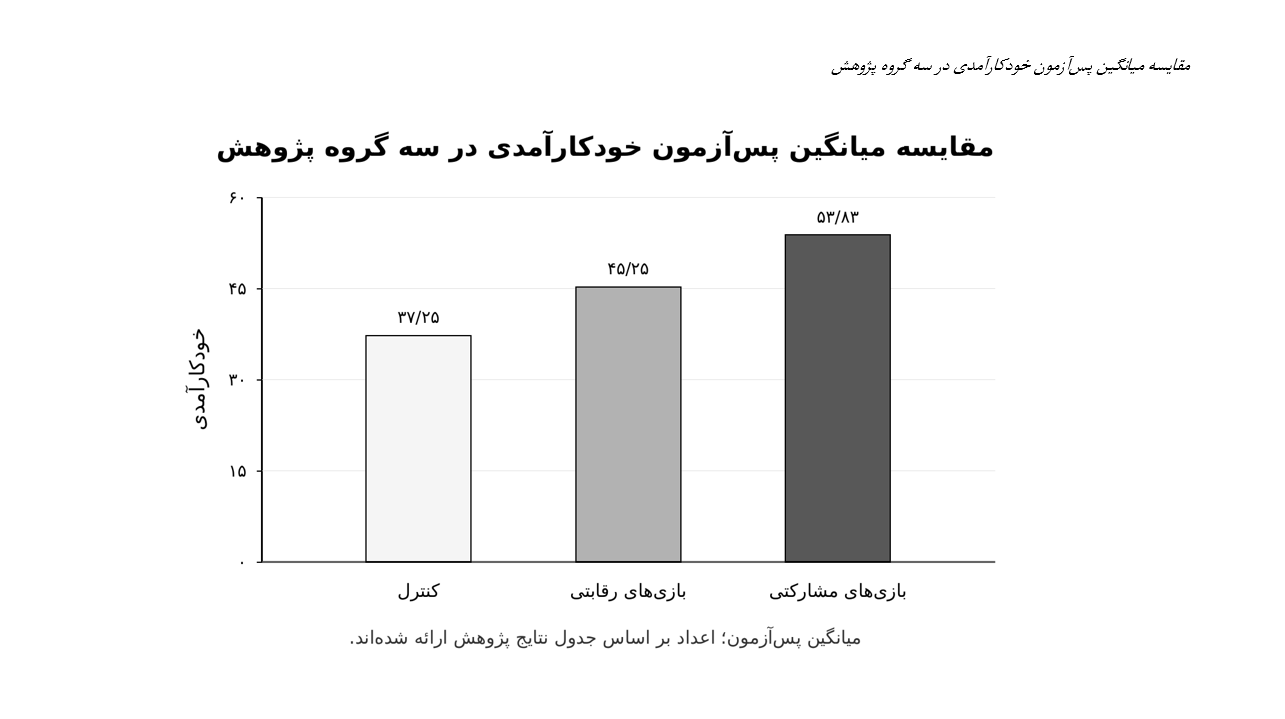
The present study aimed to compare the effectiveness of two play-based approaches, cooperative and competitive games, on self-efficacy and motor proficiency in children with Developmental Coordination Disorder (DCD). The research method was quasi-experimental with a pre-test and post-test design including a control group. The statistical population consisted of female students aged 9 to 12 years with DCD in Khoy city during the 2021-2022 academic year. From this population, 36 participants were selected through purposive sampling and randomly assigned to three groups (12 in the cooperative games group, 12 in the competitive games group, and 12 in the control group). The experimental groups received 24 sessions of 45-minute interventions (three sessions per week) of cooperative and competitive games protocols, respectively, while the control group received no intervention other than the regular school physical education program. Research instruments included the Movement Assessment Battery for Children-Second Edition (MABC-2), the Bruininks-Oseretsky Test of Motor Proficiency-Short Form (BOT-2), and the Wheeler and Ladd Children's Self-Efficacy Scale (CSPI). Data were analyzed using Analysis of Covariance (ANCOVA). The results showed that both cooperative and competitive play approaches significantly improved self-efficacy and motor proficiency in children with DCD. Furthermore, the results of ANCOVA revealed a significant difference between the effectiveness of the two approaches, with cooperative games having a greater impact on improving self-efficacy and motor proficiency compared to competitive games. Overall, the findings indicate that cooperative games can be used as an effective motor intervention to enhance self-efficacy and motor proficiency in children with DCD. These results highlight the importance of collaborative and cooperative play-based interventions in improving the psychological and motor health of this group of children.
References
American Psychiatric, A. (2013). Diagnostic and statistical manual of mental disorders (5th ed.). American Psychiatric Publishing. https://doi.org/10.1176/appi.books.9780890425596
André, A., Deneuve, P., & Louvet, B. (2011). Cooperative learning in physical education and acceptance of students with learning disabilities. Journal of Applied Sport Psychology, 23(4), 474-485. https://doi.org/10.1080/10413200.2011.580826
Bandura, A. (1997). Self-efficacy: The exercise of control. W. H. Freeman.
Barrett, T. (2005). Effects of cooperative learning on performance of sixth-grade physical education students. Journal of Teaching in Physical Education, 24(1), 88-102. https://doi.org/10.1123/jtpe.24.1.88
Blank, R., Barnett, A. L., Cairney, J., Green, D., Kirby, A., Polatajko, H., Rosenblum, S., Smits-Engelsman, B., Sugden, D., Wilson, P., & Vinçon, S. (2019). International clinical practice recommendations on the definition, diagnosis, assessment, intervention, and psychosocial aspects of developmental coordination disorder. Developmental Medicine & Child Neurology, 61(3), 242-285. https://doi.org/10.1111/dmcn.14132
Bruininks, R. H., & Bruininks, B. D. (2005). Bruininks-Oseretsky Test of Motor Proficiency (2nd ed.). Pearson Assessment. https://doi.org/10.1037/t14991-000
Cairney, J., Hay, J. A., Faught, B. E., Wade, T. J., Corna, L., & Flouris, A. (2005). Developmental coordination disorder, generalized self-efficacy toward physical activity, and participation in organized and free play activities. The Journal of Pediatrics, 147(4), 515-520. https://doi.org/10.1016/j.jpeds.2005.05.013
Cairney, J., Rigoli, D., & Piek, J. (2013). Developmental coordination disorder and internalizing problems in children: The environmental stress hypothesis elaborated. Developmental Review, 33(3), 224-238. https://doi.org/10.1016/j.dr.2013.07.002
Erskine, N., Barratt, J., & Cairney, J. (2024). Paediatric motor difficulties and internalising problems: An integrative review on the environmental stress hypothesis. Frontiers in Pediatrics, 12, 1320338. https://doi.org/10.3389/fped.2024.1320338
Farhat, F., Denysschen, M., Mezghani, N., Kammoun, M. M., Gharbi, A., Rebai, H., & et al. (2024). Activities of daily living, self-efficacy and motor skill related fitness and the interrelation in children with moderate and severe developmental coordination disorder. PLOS ONE, 19(4), e0299646. https://doi.org/10.1371/journal.pone.0299646
Gallahue, D. L. (2010). Understanding motor development in children and youth. Proceedings of the 6th International Scientific and Expert Symposium "Contemporary Views on the Motor Development of a Child",
Grineski, S. (1996). Cooperative learning in physical education. Human Kinetics.
Henderson, S. E., Sugden, D. A., & Barnett, A. L. (2007). Movement Assessment Battery for Children (2nd ed.). Pearson. https://doi.org/10.1037/t55281-000
Hosseinchari, M. (2008). A comparison of perceived self-efficacy for social interactions in male and female junior high school students. [Journal/source details should be completed if available]. https://www.sid.ir/paper/67642/en
Karabak, M., Akıncı, M. A., Yıldırım Demirdöğen, E., & Bozkurt, A. (2025). Prevalence and associated factors of developmental coordination disorder in primary school children. European Child & Adolescent Psychiatry, 34(2), 779-790. https://doi.org/10.1007/s00787-024-02526-3
Mohammadzadeh, S., Habibifar, F., Ramezanzade, H., Jafarzadeh, M., Rabavi, A., Kurnaz, M., & et al. (2025). The effect of a play-centered SPARK physical education program on motor proficiency and self-efficacy in children with developmental coordination disorder. Sport Sciences for Health, 21(3), 1613-1621. https://doi.org/10.1007/s11332-025-01385-y
Nobre, G. C., Valentini, N. C., Ramalho, M. H., & Sartori, R. F. (2019). Self-efficacy profile in daily activities: Children at risk and with developmental coordination disorder. Pediatrics & Neonatology, 60(6), 662-668. https://doi.org/10.1016/j.pedneo.2019.03.012
Ojeda-Troncoso, N., & Campos-Campos, K. (2025). Adapted sports-based games with cooperative and competitive approaches on social and motor skills in early primary school students. Perceptual and Motor Skills, 132(6), 1332-1350. https://doi.org/10.1177/00315125251342622
Rivard, L., Pollock, N., Siemon, J., & Missiuna, C. (2016). Developmental coordination disorder. In Campbell's physical therapy for children (5th ed.). Elsevier. https://books.google.com/books?hl=en&lr=&id=ruJgDwAAQBAJ&oi=fnd&pg=PA398&dq=Rivard,+L.,+et+al.+(2016).+Developmental+coordination+disorder.+Campbell%27s+physical+therapy+for+children,+Elsevier.+%09&ots=ApgNduc_3Y&sig=XDSE88ibsii0x5R0Q2WsY1VFM0M
Vanden Auweele, Y., Bakker, F., Biddle, S., Durand, M., & Seiler, R. (1999). Psychology for physical educators. Human Kinetics.
Wheeler, V. A., & Ladd, G. W. (1982). Assessment of children's self-efficacy for social interactions with peers. Developmental Psychology, 18(6), 795-805. https://doi.org/10.1037/0012-1649.18.6.795
Zwicker, J. G., Missiuna, C., Harris, S. R., & Boyd, L. A. (2012). Developmental coordination disorder: A review and update. European Journal of Paediatric Neurology, 16(6), 573-581. https://doi.org/10.1016/j.ejpn.2012.05.005
Zwicker, J. G., Suto, M., Harris, S. R., Vlasakova, N., & Missiuna, C. (2018). Developmental coordination disorder is more than a motor problem: Children describe the impact of daily struggles on their quality of life. British Journal of Occupational Therapy, 81(2), 65-73. https://doi.org/10.1177/0308022617735046
Downloads
Publication Timeline
- Submitted
- Revised
- Accepted
Issue
Section
License
Copyright (c) 2025 زهرا گلصنملو (نویسنده); مهدیه قره لر

This work is licensed under a Creative Commons Attribution-NonCommercial 4.0 International License.